Description

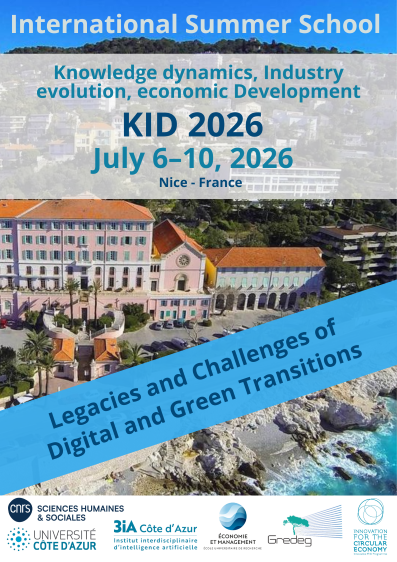
KID2026 offers students theoretical and empirical lectures on knowledge dynamics, industry evolution, and economic development. Following its tradition, the school aims to attract students interested in studying a broad range of topics such as innovation and industrial dynamics, economics of science, entrepreneurship, corporate governance, regional development, urban innovation, and environmental innovation.

This year’s edition will focus on the Green and Digital transitions. These transitions are relevant because they shape productivity, innovation, and climate resilience while reconfiguring industrial organization and the labor market. For instance, digital technologies can accelerate decarbonization — via measurement, optimization, and system integration — whereas environmental goals can steer digital investment toward efficiency. Moreover, in this context, other effects such as rebound effects can emerge. Understanding the evolution of green and digital technologies, as well as their interplay, is essential for policymakers to steer society through these two transitions. A common element of the green and digital transitions is that they are expected to significantly affect the structure and level of employment, creating new jobs while displacing others. On this topic, two lectures at KID2026 will focus on teaching students about the latest advances in the study of the labor market for workers trained in digital competencies and on the impact of this training on workers’ careers. These two lectures will be supported by the AI-Edu (2025) project.

Continuing its longstanding tradition, KID2026 will offer students lectures from outstanding scholars and provide an arena for them to present their ongoing work. Given the multidisciplinary nature of digital and green transitions, KID2026 aims to attract students from disciplines beyond economics and management, including sociology, engineering, and computer science.

Lecturers

Carolina Castaldi (Utrecht University)
Alessandra Colombelli (Politecnico di Torino)
Erik Hille (HHL Leipzig Graduate School of Management)
Francesco Lamperti (Scuola Superiore Sant'Anna)
Valerio Sterzi (University of Bordeaux)
Sotaro Shibayama (Tokyo University)
Francesco Quatraro (Torino University)
Pierre Monhen (UNU-MERIT)

Venue

The KID summer school will take place at Le Saint Paul Hotel-Maison du Séminaire, 29 Bd Franck Pilatte, Nice (France).

Application package

PhD students, postdocs, and young researchers willing to attend the summer school can apply by submitting a single PDF document including:
-A short CV
-A motivation letter for participating in the summer school
-A research proposal (maximum 5 pages) or a full paper to present during the student presentation sessions.
Applications can be submitted at the following link: submit here!

Deadlines

Deadline for application: 31 March, 2026
Notification of acceptance: 2 May, 2026
Registration and accommodation fee payment: Deadline 1 June, 2026
Full paper submission: 1 June, 2026

Participation fee

Summer school fees for participants (700 euros) include the registration to the summer school (access to all summer school lectures and presentations, 7 breaks, 4 lunches, 2 summer school dinners), and hotel accommodation at Saint Paul Hotel - Maison du Séminaire (twin rooms accommodation, i.e., 2 KID participants per room, with breakfast included, 4 nights, arrival on Monday, departure on Friday.

Fees can be paid only by credit card and online.

Contact

For any questions, please contact us at kid2026@sciencesconf.org

Funders

EFELIA
EUR-ELMI
ANR
University of Torino

Organizing committee

Jackie Krafft (Université Côte d’Azur and CNRS-GREDEG, France)
Marco Baudino (Université Côte d’Azur and CNRS-GREDEG, France)
Cécile Cézanne (Université Côte d’Azur and CNRS-GREDEG, France)
Sofia Patsali (Université Côte d’Azur and CNRS-GREDEG, France)
Michele Pezzoni (Université Côte d’Azur and CNRS-GREDEG, France)
Francesco Quatraro (University of Turin, Italy)
Simone Vannuccini (Université Côte d’Azur and CNRS-GREDEG, France)
Ulrike Mayrhofer (Université Côte d’Azur and GRM)
David Huron (Université Côte d’Azur and GRM)

Loading... Loading...